The final installment of the "Getting into the Weeds" Workshop Series is now available on Perennia's YouTube channel: https://www.youtube.com/watch?v=5lMjHtcBZcM&t=3s
In this webinar, Gavin Graham, New Brunswick Minor Use Coordinator, and Peter Burgess, Perennia Integrated Pest Management Specialist discuss recent changes in the last few years to pesticides. In addition, Angela Gourd, Nova Scotia Department of Agriculture Plant Protection Coordinator, takes participants through the results from strawberry, onion, and carrot weed surveys.
Be sure to check out the other videos in this series, including "Winter Greens Production" with David Blanchard of Pleasant Hill Farm, and "Food Safety Success" with Shelly MacDonald and Elaine Grant of Perennia's Food Safety Team.

Showing posts with label Strawberry. Show all posts
Showing posts with label Strawberry. Show all posts
BEYONG THE 3R’s – FINDING A PATH TO SUSTAINABLE PACKAGING
Friday, March 6, 2020
Perennia is hosting a session on sustainable packaging that might interest you:
|
For more information or to register, please check out Perennia's Events page.
This is part of the “Take Your Product to Market” series, happening over the next several weeks which includes webinars on food safety, labeling, packaging for your brand, and preparing for customer meetings.
WORKSHOP: RECORD KEEPING FOR FINANCIAL AND FOOD SAFETY SUCCESS
Tuesday, February 25, 2020
It doesn’t matter if you’re a start-up, or a seasoned business owner who grows crops of any kind. This session is for anyone who wants a gold star in field and crop record keeping and facilitate meeting Canada GAP certification and streamlining that process through good bookkeeping.
Please join us for the next Getting Into the Weeds session on Thursday, March 5th from 9:00 - 4:00 at the Hilton Garden Inn near the Halifax Airport. Registration is required, the cost of the workshop is $50 and includes lunch. Click here to register.
Excellent crop records are needed for:
This hands-on workshop will give you tools for recording and retrieving the information you need to satisfy the above requirements.
Participants will be using their own information to create a data file and enter records; not sample data. The instructor will be available to all participants to answer questions and provide guidance. Handouts will be provided. Please note there will be some pre-workshop prep by participants.
Please join us for the next Getting Into the Weeds session on Thursday, March 5th from 9:00 - 4:00 at the Hilton Garden Inn near the Halifax Airport. Registration is required, the cost of the workshop is $50 and includes lunch. Click here to register.
Excellent crop records are needed for:
- 1. On farm food safety documentation
- 2. Buyer requirements
- 3. Traceability
- 4. Evaluation of results - production and financial
This hands-on workshop will give you tools for recording and retrieving the information you need to satisfy the above requirements.
Participants will be using their own information to create a data file and enter records; not sample data. The instructor will be available to all participants to answer questions and provide guidance. Handouts will be provided. Please note there will be some pre-workshop prep by participants.
UPCOMING CANADA GAP WORKSHOPS
Thursday, February 6, 2020
Canada GAP Workshops
The updated versions of the CanadaGAP Food Safety Manuals have been released and will take effect on April 1, 2020. Become familiar with these new updates at one of Perennia’s CanadaGAP workshops happening in March with Kim Best from Prospect Agri-Services. You can find the full details in the poster. Don’t miss out on this opportunity! Registration is now open on our website.

Contact Us
Our Quality and Food Safety Team can help in a variety of ways. If you have training questions, contact Shelly MacDonald. If you need help with a regulatory issue, contact Rick Kane. If you have any other food safety concerns or questions contact Elaine Grant, and she will direct your query to the appropriate team member.
Upcoming Webinar "Food Safety Success - Are You Ready?"
Tuesday, January 28, 2020
"Getting into the Weeds” session – Food Safety Success – Are you ready?Join us on Wednesday, February 12, 2020, 1pm-3pm where you’ll hear from members of Perennia’s Quality and Food Safety Team, Elaine Grant and Shelly MacDonald. Elaine and Shelly will give an overview of Safe Food for Canadians Regulations (SFCR) requirements pertaining to fresh produce and how SFCR affects NS produce growers. They will also discuss how to reopen the door to retail while meeting regulations and making it work for your operation. You will also be provided with an overview of the Nova Scotia Agri-Food Accelerator Program. This session will be hosted as an online webinar, so you can watch from the comfort of your own home or a place that is most convenient for you! Register on Perennia's website. Viewing parties for this webinar are being organized at several points around the province*. If you are interested in seeing if there is a location near you, please contact Jill MacDonald and see the webinar on the Big Screen! *Please note, this is only a viewing of the webinar which will be broadcast from another location. Questions can be asked to the speaker through the chat function during the session or can be emailed to Jen Haverstock at the end of the session for a response. |
Changes Coming for the Use of Chlorothalonil (Bravo®) Products
Monday, January 20, 2020
By Jill MacDonald, Perennia Research Associate

Introduction of Closed-system Transfer

For further details on changes to Bravo products, please visit Syngenta.ca.
Chlorothalonil is a contact and protectant fungicide that controls a broad range of fungal diseases. It is used on a number of crops. Due to the recent re-evaluation of chlorothalonil by the Pest Management Regulatory Agency (PMRA) there are changes that will affect how growers use the product, in relation to how it is mixed, loaded and applied. While some formulations have experienced changes to product use (Bravo®ZN), others have been discontinued altogether.
The re-evaluation has caused a discontinuation of Bravo 500 and Ridomil Gold SL/Bravo Twin-Pak formulations. The final day that these products will be available for purchase is May 10th, 2020, and the final day that growers will be able to make applications of these products is May 10, 2021. After this time, it will be the responsibility of the grower to properly dispose of any leftover product.
How will these changes affect how I use chlorothalonil products?
Changes to Number of Applications Permitted
There have been several use pattern changes made on Chlorothalonil labels, so it is important to check how your crop is affected. The full list of changes, including application rates and REIs can be found here. Please confer with up-to-date labels before use.
Changes to the number of applications permitted per season by crop:
Crop | 2019 | 2020 |
Blueberry (Highbush) | 3 | 2 |
Cabbage | 5 | 2 |
Celery, field | 9 | 2 |
Cherries (sweet and sour) | 4 | 3 (2 spring + 1 post-harvest) |
Cole Crops | 5 | 1 |
Cranberry | 3 | 1 |
Cucurbit Vegetables | 7 | 2 |
Onion, dry bulb | 3 | 2 |
Onion, green bunching | 5 | 2 |
Peach, nectarine | 4 | 3 (2 spring + 1 dormant) |
Potato, table | 12 | 3 |
Strawberry | 3 | 3 (2 spring + 1 dormant) |
Tomato (not for processing) | 9 | 2 |
Wheat | 3 | 2 |
Additional PPE, Buffer Zone Changes and REI
New requirements have been put in place to protect the applicator and persons who are handling the product, by increasing the amount of personal protective equipment (PPE) required. It is recommended to read the revised product label to obtain information on PPE and changes to the buffer zone requirements and restricted entry intervals (REI) for certain activities. Growers are reminded to have the updated label available to staff members who may come in contact with the product, as well as making them aware of the changes.
Implementation of Vegetative Filter Strips
Use of chlorothalonil requires a 10 meter (32’) vegetative filter strip (VFS) to be planted, if there is an aquatic ecosystem downhill from the field or sprayed area. A VFS is different than spray buffer zones: the filter strip is typically perennial, hardy, deep-rooted native vegetation that can slow runoff and filter out any pesticides that the runoff may contain.

 |
Figures were obtained from: |
Introduction of Closed-system Transfer
The PMRA will now require growers, under certain circumstances, to use a closed-transfer and application system. The closed-system transfer specifically focuses on mixing and loading of the product. All potato applications, or any applications when more than 340 kg a.i. are handled in one day will be subject to these requirements. When product is directly transferred from the tote to the sprayer tank, this will now require dry poppet connections which comply with closed-transfer. Dry poppets are available from several manufactures and are also known by several names, such as dry poppet couplings or valves. Syngenta currently supplies a female dry poppet to male cam lever adapter with each tote of Bravo®ZN. Many chemical handling systems and sprayers are fitted with cam lever connections from the factory, in this case you can purchase a dry poppet to cam lever adapter. The existing dry poppet valves on the 450L totes of Bravo®ZN are already compliant with the closed-system transfer requirement and will not need to be altered.

 |
Figures were obtained from:
Additional Important Changes
Hand harvesting of processing tomatoes and application through irrigation systems on strawberries and cucurbits (cantaloupe, muskmelon, honeydew, squash, pumpkin, watermelon and cucumber) is now prohibited.
For further details on changes to Bravo products, please visit Syngenta.ca.
Changes Coming for the Use of Chlorothalonil (Bravo®) Products
By Jill MacDonald, Perennia Research Associate
Introduction of Closed-system Transfer
For further details on changes to Bravo products, please visit Syngenta.ca.
Chlorothalonil is a contact and protectant fungicide that controls a broad range of fungal diseases. It is used on a number of crops. Due to the recent re-evaluation of chlorothalonil by the Pest Management Regulatory Agency (PMRA) there are changes that will affect how growers use the product, in relation to how it is mixed, loaded and applied. While some formulations have experienced changes to product use (Bravo®ZN), others have been discontinued altogether.
The re-evaluation has caused a discontinuation of Bravo 500 and Ridomil Gold SL/Bravo Twin-Pak formulations. The final day that these products will be available for purchase is May 10th, 2020, and the final day that growers will be able to make applications of these products is May 10, 2021. After this time, it will be the responsibility of the grower to properly dispose of any leftover product.
How will these changes affect how I use chlorothalonil products?
Changes to Number of Applications Permitted
There have been several use pattern changes made on Chlorothalonil labels, so it is important to check how your crop is affected. The full list of changes, including application rates and REIs can be found here. Please confer with up-to-date labels before use.
Changes to the number of applications permitted per season by crop:
Crop | 2019 | 2020 |
Blueberry (Highbush) | 3 | 2 |
Cabbage | 5 | 2 |
Celery, field | 9 | 2 |
Cherries (sweet and sour) | 4 | 3 (2 spring + 1 post-harvest) |
Cole Crops | 5 | 1 |
Cranberry | 3 | 1 |
Cucurbit Vegetables | 7 | 2 |
Onion, dry bulb | 3 | 2 |
Onion, green bunching | 5 | 2 |
Peach, nectarine | 4 | 3 (2 spring + 1 dormant) |
Potato, table | 12 | 3 |
Strawberry | 3 | 3 (2 spring + 1 dormant) |
Tomato (not for processing) | 9 | 2 |
Wheat | 3 | 2 |
Additional PPE, Buffer Zone Changes and REI
New requirements have been put in place to protect the applicator and persons who are handling the product, by increasing the amount of personal protective equipment (PPE) required. It is recommended to read the revised product label to obtain information on PPE and changes to the buffer zone requirements and restricted entry intervals (REI) for certain activities. Growers are reminded to have the updated label available to staff members who may come in contact with the product, as well as making them aware of the changes.
Implementation of Vegetative Filter Strips
Use of chlorothalonil requires a 10 meter (32’) vegetative filter strip (VFS) to be planted, if there is an aquatic ecosystem downhill from the field or sprayed area. A VFS is different than spray buffer zones: the filter strip is typically perennial, hardy, deep-rooted native vegetation that can slow runoff and filter out any pesticides that the runoff may contain.
|
Figures were obtained from: |
Introduction of Closed-system Transfer
The PMRA will now require growers, under certain circumstances, to use a closed-transfer and application system. The closed-system transfer specifically focuses on mixing and loading of the product. All potato applications, or any applications when more than 340 kg a.i. are handled in one day will be subject to these requirements. When product is directly transferred from the tote to the sprayer tank, this will now require dry poppet connections which comply with closed-transfer. Dry poppets are available from several manufactures and are also known by several names, such as dry poppet couplings or valves. Syngenta currently supplies a female dry poppet to male cam lever adapter with each tote of Bravo®ZN. Many chemical handling systems and sprayers are fitted with cam lever connections from the factory, in this case you can purchase a dry poppet to cam lever adapter. The existing dry poppet valves on the 450L totes of Bravo®ZN are already compliant with the closed-system transfer requirement and will not need to be altered.
|
Figures were obtained from:
Additional Important Changes
Hand harvesting of processing tomatoes and application through irrigation systems on strawberries and cucurbits (cantaloupe, muskmelon, honeydew, squash, pumpkin, watermelon and cucumber) is now prohibited.
For further details on changes to Bravo products, please visit Syngenta.ca.
2019 Strawberry Season Update #1- Aphids
Wednesday, July 17, 2019
Perennia is continuing the strawberry aphid monitoring project this season. Strawberry aphids are the primary vector of the strawberry viruses (strawberry mild yellow edge virus and strawberry mottle virus) found in Nova Scotia, and by monitoring the aphid we aim to prevent further spread of viruses in the province. The risk of new infection is highest during the strawberry aphid flight period when winged aphids can move large distances to new fields and spread infection. As of last week's aphid trapping and monitoring we found our first winged strawberry aphids. Because of this it is crucial to continue to monitor and scout for winged and wingless strawberry aphids in your fields.
 |
| Winged strawberry aphid (scale 1mm) |
 |
| Adult strawberry aphid (scale 1mm) |
To prevent virus spread it is important to protect new plantings by controlling aphids in established fruiting fields. Seeing that we are in the midst of harvest there are limited products available for fruiting fields but there are a few tools with short (0 day or 1 day) pre-harvest intervals. For information on control options please see Strawberry Management Guide 2019.
2018 Strawberry Season Update #4 Renovation
Thursday, August 2, 2018
The June-bearing strawberry harvest has ended, and now it's time to renovate. The main purpose of renovating is to re-establish a healthy, vigorous stand of plants so that there is a high yield potential for the next crop. Fruit bud initiation begins in mid-August so it crucial to renovate as soon as possible after harvest to optimize this process. Renovating also gives an opportunity to control weed problems in the field
Post-emergent herbicide applications can be used before and after mowing depending on the product being used and the target weed. For information on products available please refer to Perennia's Guide to Weed Management in Strawberry or New Brunswick's Strawberry IPM Weed Management Guide.
Mowing strawberry leaves is the next step in renovating, which stimulates early initiation of fruit buds, controls plant density resulting in larger fruit size, and can reduce inoculum levels for certain leaf diseases and botrytis fruit rot. Following mowing, fertilizer should be applied and adequate soil moisture levels maintained (through either irrigation or rainfall) to support new growth. For more information on renovating strawberries please refer to Perennia's Five Renovation Steps for Strawberries.
2018 Strawberry Season Update #3 - Aphid Flight
Thursday, July 5, 2018
In this week's aphid trapping and monitoring we found our first winged strawberry aphids. This aphid species is the primary vector of the strawberry viruses (strawberry mild yellow edge virus and strawberry mottle virus) found in Nova Scotia. During the strawberry aphid flight period strawberry fields are at their highest risk of becoming infected with viruses, as winged strawberry aphids can travel long distances carrying viruses to previously uninfected fields. Because of this it is crucial to continue to monitor and scout for winged and wingless strawberry aphids in your fields.
It is also important to continue to manage for strawberry aphids during this period. Since we are in the middle of harvest there are limited products available for fruiting fields but there are a few tools with short (0 day or 1 day) pre-harvest intervals. For information on control options please see Perennia's Strawberry Management Guide 2018.
 |
| Winged strawberry aphid. |
2018 Strawberry Season Update #2 - APHIDS
Friday, June 29, 2018
Perennia is continuing the strawberry aphid monitoring project this season. The strawberry aphid is the primary vector of viruses in strawberries, and by monitoring the aphid we aim to prevent further spread of viruses in the province. The risk of new infection is highest during the strawberry aphid flight period when winged aphids can move large distances to new fields and spread infection. As of this week’s aphid trapping and monitoring we have not found any winged strawberry aphids. There will be a blog post when the first winged strawberry aphids are picked up as well as update blogs on the status of the flight. At this point it is important to continue to scout for winged and wingless strawberry aphids in your fields.
 |
| Adult strawberry aphid |
 |
| Winged strawberry aphid |
To prevent virus spread it is important to protect new plantings by controlling aphids in established fruiting fields. Seeing that we are in the midst of harvest there are limited products available for fruiting fields but there are a few tools with short (0 day or 1 day) pre-harvest intervals. For information on control options please see Perennia's Strawberry Management Guide 2018 .
2018 Strawberry Season Update #1
Thursday, June 7, 2018
The 2018 strawberry season is underway with bloom well advanced going into June. This blog will act as an update on what has been observed in the field so far, as well as a reminder of thing to keep an eye on in the near future.
Frost Damage:
This has been a particularly bad year for frost, with many fields experiencing at least some damage. As you scout your fields for damage, we wanted to provide you with some reference pictures for what you should be looking for. Frost damage is primarily characterized by blossoms with with black or brown pistils in the center or browning developing fruit. The damaged blossoms will either have no fruit development or produce misshapen fruit that can resemble tarnish plant bug damage. Frost can also cause leaves to crinkle which can resemble cyclamen mite damage.
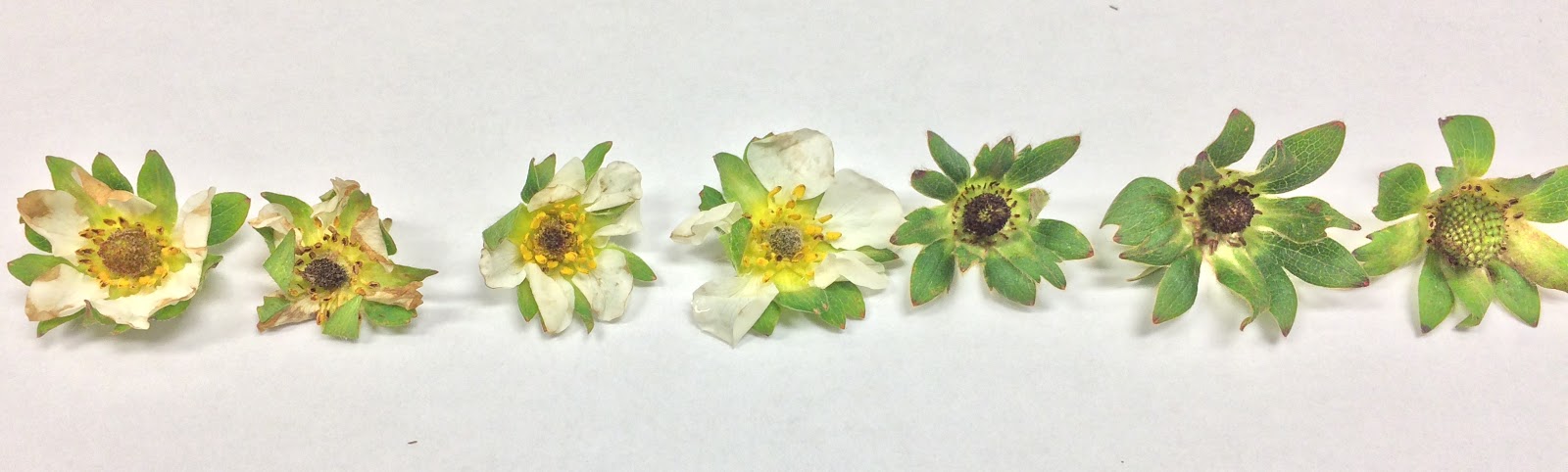 |
| A spectrum of frost damage on different stages of blossom and fruit development. |
Botrytis:
With the repeated frost events and particularly in cases where water was applied as frost protection, it is important to be diligent with botrytis sprays. Most June bearing fields are in blossom, which is the most important growth stage to protect berries from botrytis infection. To ensure that you are getting the best protection possible, it is strongly encouraged that growers use a single-site fungicide (not a Group M Fungicide). Please be mindful of resistance management and be sure to rotate between products from different fungicide groups.
For a list of products available for botrytis management (and other pests) in strawberries please refer to the Perennia Strawberry and Disease Management Schedule.
Subscribe to:
Posts (Atom)